Prevention

A healthy adult has 32 teeth. A tooth consists of the crown (the visible part), the neck (below the gums), and the root (in the maxillary sinus). In principle, we can replace any part with an artificial tooth. We will only recommend this if there is no other option. The foundation of our actions is preserving your natural teeth; prevention is key! Prevention is the foundation of a healthy approach to dentistry. Proper care is, of course, the best way to prevent problems. However, your gums and jawbone can become inflamed for various reasons. Prolonged inflammation can cause your teeth to lose their firm anchorage. Our dental hygiene assistants will clean your teeth and teach you how to care for them properly.

Dental Center Netherlands (TCN) has dental practices throughout North Holland. Including in Alkmaar, Bergen, Castricum, Haarlem, Heerhugowaard, Westzaan, Zaandam and Beaverwijk.
Register as a patient

Action to remove tartar

Counter sales

All the products we recommend are available at the counter. We do this because we have found that in everyone's hectic lives, little time is left to buy the right products for oral health. You need not worry about finding the product cheaper elsewhere, as we maintain the lowest retail prices for you.

Seals

Through sealants and fluoride treatments, we can minimize the risk of tooth decay. This purely preventive method ensures your child has good oral hygiene and an excellent foundation for beautiful, healthy teeth throughout their later years.

Sealings without etching fluid

Oral hygiene in children

It is perfectly fine to have a sweet treat occasionally. Limit the consumption of sweet products to main meals and eat a maximum of two snacks in addition. With this amount, saliva can still protect the teeth against cavities.

More information

Periodontitis

Periodontitis is a disease responsible for the premature loss of teeth. Our dental hygiene assistants ensure that the preservation of beautiful and strong teeth is pursued through the regular removal of tartar and instruction on proper cleaning methods.

Learn more about periodontitis

Seals without the use of etching fluid

When applying sealants, we do not use an unpleasant jet of water or a nasty, acidic liquid (which might startle somewhat anxious children), but a self-etching sealant. This is truly a breakthrough in the treatment of sealants for the very little ones.

The difference between the preventive assistant and the dental hygienist

We're often asked what the difference is between a preventive assistant and a dental hygienist. That's why we've briefly described the tasks of both professionals.

Tasks of the prevention assistant:

  • Taking initial anamnesis (medication use/health questionnaire);
  • Performing a plaque color test;
  • Mapping of gum condition (DPSI score);
  • Removal of tartar and dental plaque above the gums;
  • Polishing of teeth and molars;
  • Teeth whitening;
  • Smoothing root surfaces;
  • Applying fluoride;
  • Provide information and instruction on dental care.

In addition, after completing additional training, a preventive assistant can also perform other procedures such as sealing teeth and molars.
The main difference is that a dental hygienist is a higher professional education (HBO)-trained paramedic who is continuously assessed for compliance with quality standards. The title of dental hygienist is therefore protected by the Individual Healthcare Professions Act (BIG). The tasks performed by a dental hygienist are primarily focused on prevention – preventing gum problems and cavities (caries). Furthermore, the dental hygienist specializes in the treatment of gum diseases such as gingivitis and periodontitis. This is part of the curative treatments (= aimed at healing). This combination of tasks makes the dental hygienist a specialist in overall oral health.

In short, you could say that the work of the dental hygienist begins where the work of the preventive assistant ends.

Duties of the dental hygienist:

  • Taking initial anamnesis (medication use/health questionnaire);
  • Performing a plaque color test;
  • Mapping of gum condition (DPSI score);
  • Removal of dental plaque, deposits and tartar above and below the gums;
  • Applying fluoride;
  • Smoothing root surfaces;
  • Providing advice and information about, among other things, the development of caries;
  • Gum disease (gingivitis and periodontitis) and dietary habits;
  • Applying sealant;
  • Polishing fillings;
  • Cleaning of root surfaces under the gums;
  • Treating small cavities (on the dentist's orders);
  • Taking X-rays (on order and under the supervision of the dentist);
  • Taking dental impressions;
  • Administering a local anesthetic.

Dental hygienists can work in a general dental practice, a periodontal clinic, or as an independent dental hygienist with their own practice. They can also specialize in periodontics, implantology, or orthodontics. Furthermore, like dentists, dental hygienists are responsible for recording all relevant data in the patient file. Dental hygienists who meet the quality requirements are registered in the Quality Register for Dental Hygienists (KRM).

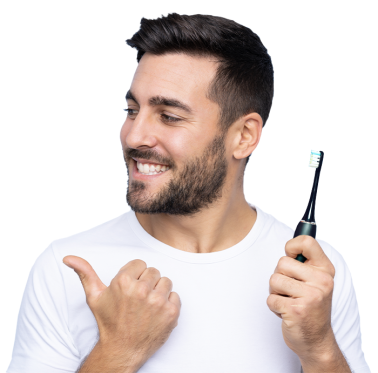
Promotion: free toothbrush with registration

No waiting lists, new patients are welcome!

Registering as a new patient at TCN is easy – simply choose your location and log in.